GM Holds 64% of Indonesia's EV Market — and 6% of America's
A General Motors EV joint venture has captured 64% of all electric vehicle sales in Indonesia — the fourth largest country in the world — at a moment when GM's domestic EV business faces real headwinds.

A General Motors EV joint venture has captured 64% of all electric vehicle sales in Indonesia — the fourth largest country in the world — at a moment when GM's domestic EV business faces real headwinds.
In the United States, GM holds roughly 6–8% of the EV market, ranking second behind Tesla's 54% dominance. The Chevrolet Equinox EV is currently its volume leader and the third best-selling EV in America — a creditable position, but a distant one. The rescission of the federal EV tax credit has further complicated the growth outlook. The Indonesia story reads very differently.
The JV structure
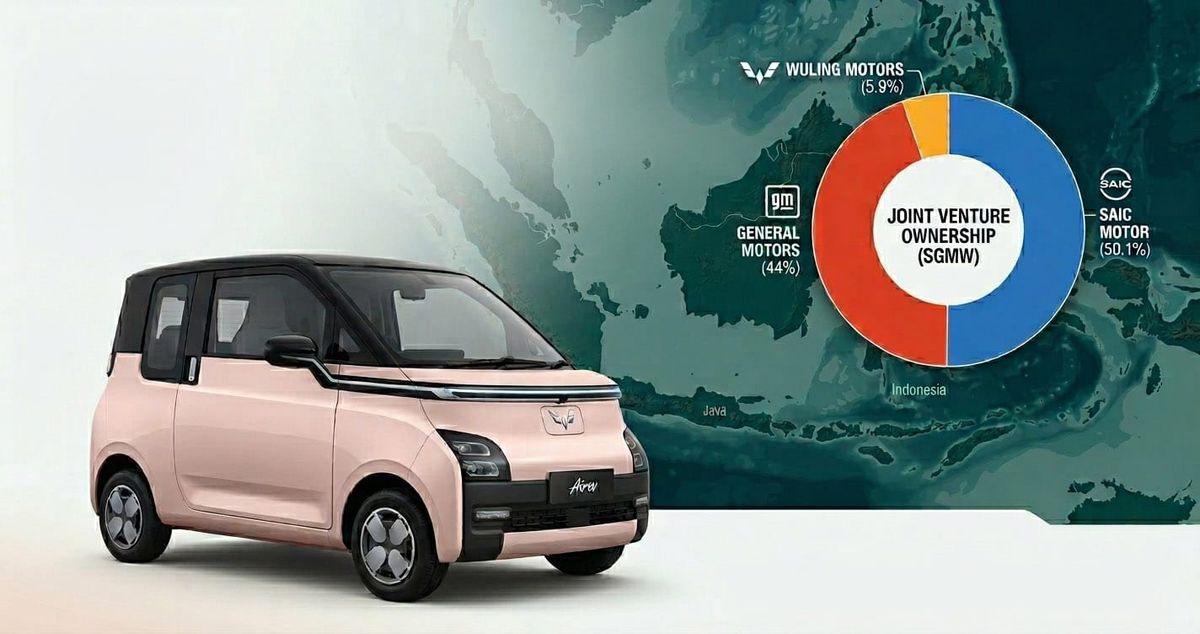
The vehicle driving that 64% share is the Wuling Air EV, produced by SAIC-GM-Wuling Automobile (SGMW) — a three-way joint venture formed in 2002. SAIC Motor holds 50.1%, GM holds 44%, and Liuzhou-based Wuling Motors holds 5.9%. SGMW operates entirely separately from GM's main China passenger-car JV and was purpose-built for mass-market vehicles in price-sensitive emerging markets.
GM earns dividends and technology royalties from the Air EV. Its quarterly filings don't highlight it. Western automotive coverage rarely investigates it.
Who Really Makes Indonesia's #1 EV?
The Wuling Air EV commands nearly two-thirds of Indonesia's EV market. Behind it: a three-way joint venture connecting a Chinese state giant, an American automaker, and a regional OEM most people have never heard of.
|
State-owned enterprise
SAIC Motor
Shanghai Automotive
Industry Corp. 50.1%
ownership stake
|
American automaker
General Motors
GM China — Detroit, USA
NYSE: GM 44%
ownership stake
|
Regional OEM
Liuzhou Wuling
Wuling Motors Co., Ltd.
Guangxi, China 5.9%
ownership stake
|
| Wuling Air EV |
|
64% |
| Hyundai Ioniq 5 |
|
~16% |
| BYD (all models) |
|
~11% |
| All others |
|
~9% |
|
64%
EV market share
Indonesia Q1 2024
|
$13K
starting price
~half nearest rival
|
40K+
units produced
locally in West Java
|
77
Indonesian suppliers
in local supply chain
|
Market share data: GAIKINDO Q1 2024 · competitor figures approximate based on available data
Production & local content: SGMW Indonesia press releases · Indonesian Ministry of Industry
Why it works
The Air EV starts at around $13,000 USD, assembled locally in Cikarang, West Java, drawing on 77 Indonesian component suppliers. The nearest EV competitor in Indonesia starts above $30,000. In a market where median monthly household income sits below $500, that gap is structural, not promotional.
Each partner contributes something the others can't replicate alone. SAIC provides state-backed financing and Chinese manufacturing scale. GM provides engineering credibility and a brand association that opens doors in government and fleet procurement across the region. Wuling brings three decades of high-volume production for cost-sensitive buyers.
ASEAN is next
The conventional GM narrative focuses on its US and China positions — one recovering slowly, one under pressure from domestic brands. But SGMW is competing in neither of those markets. It's operating in economies where Chinese manufacturing cost structures, paired with international credibility, produce a position no one else occupies at this price point.
Indonesia is the proof of concept. The rest of ASEAN is watching. GM holds 44% of that upside.